WhatsApp Rolls Out Guest Calls For Non-Account Users
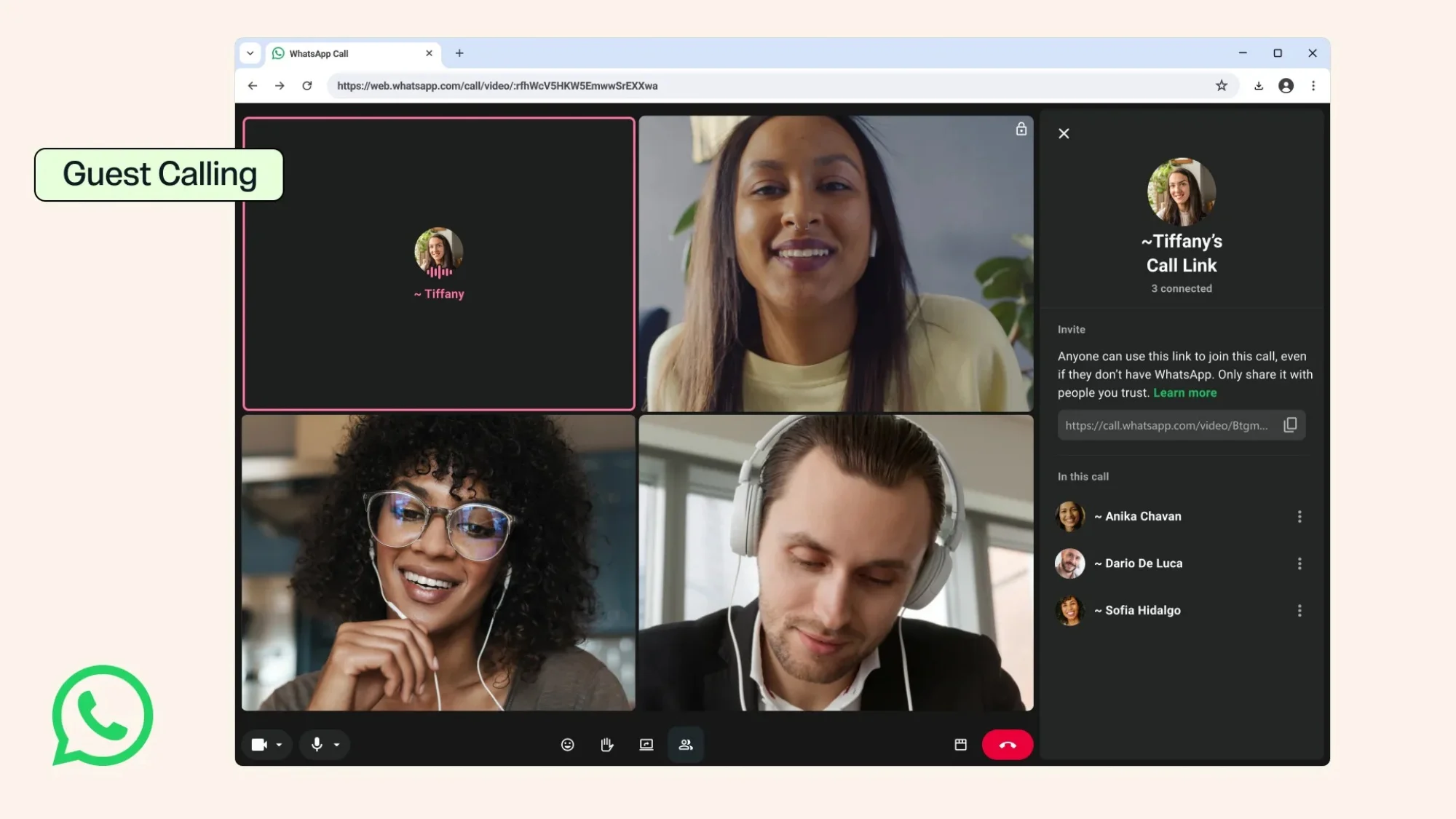
WhatsApp has officially rolled out guest calls, allowing individuals without an account to join audio and video calls via a web browser link. Announced on 15 October 2026 via an official blog post, the update maintains end-to-end encryption, imposes no time limits, and remains completely free of charge. Malaysian users can now conduct one-on-one or group meetings with up to 32 participants without requiring clients, relatives, or external collaborators to register for the messaging platform or share their personal phone numbers.
Key Facts
The core specifications and operational parameters for WhatsApp guest calls outline platform limits, security configurations, and upcoming integrations. All guest sessions remain completely free of charge, fully end-to-end encrypted, and support group conferences of up to 32 participants without imposing call duration limits across standard desktop web browsers.
| Attribute | Value |
| Developer | |
| Announcement Date | 15 October 2026 |
| Feature | Guest calls (no account required) |
| Pricing | Free (no charge) |
| Call Duration Limit | None |
| Security | End-to-end encrypted |
| Maximum Participants | 32 people (group calls) |
| Access Method | Web browser via host-generated invitation link |
| Supported In-Call Tools | Screen sharing, hand raising, thumbs up and heart emoji reactions |
| Upcoming Capabilities | Google Calendar and Microsoft Outlook integration (due later this year) |
WhatsApp guest calls support up to 32 participants with end-to-end encryption and no time limits.
How Do WhatsApp Guest Calls Work?
WhatsApp guest calls allow unregistered participants to join encrypted voice and video sessions directly through a web browser link generated by a registered account holder. The host creates the link within the mobile application, whereas guests only need to enter their display name and await host approval before admission.
Guests without an account are placed in a waiting room upon opening the link and require explicit host admission before entering the call. To preserve privacy and security, guests cannot view participants' phone numbers, send text messages, add other individuals, or initiate calls independently. Furthermore, the meeting host retains full administrative control to remove any guest at any point during the session. In-call collaboration features remain available to guests, including screen sharing for document reviews, hand raising, and emoji reactions such as thumbs up and hearts.
Account holders must initiate call links through the Calls tab, while guests participate entirely via their web browser.
When Will Calendar Integrations Launch?
WhatsApp will introduce calendar integrations later this year, enabling users to schedule and attach call links directly within Google Calendar and Microsoft Outlook workflows. This forthcoming capability requires users to install a dedicated plugin and link their WhatsApp account, though the company has not published a specific rollout schedule.
The upcoming calendar plugin is designed to streamline appointment scheduling for business and personal productivity, integrating WhatsApp calling directly into corporate and personal calendars. However, until this deployment takes place later this year, users must continue creating links manually within the mobile app's Calls interface and sharing them across existing channels.
Calendar integrations for Google Calendar and Microsoft Outlook will require a dedicated plugin and account connection before deployment later this year.
What It Means for Malaysian Buyers
WhatsApp guest calls provide Malaysian users with an immediate, cost-free video conferencing option that operates without forcing clients or family members to register for the service. Because the feature operates globally via the standard web interface, it is available immediately across Malaysian mobile and fixed broadband networks at zero additional cost.
While the announcement outlines no Malaysia-specific commercial packages or localized hardware tie-ins, the capability functions across local networks including CelcomDigi, Maxis, U Mobile, and Unifi. The absence of subscription fees and account requirements offers practical utility for local small businesses, informal consultations, and overseas family communications, matching core features of commercial conferencing tools without the 40-minute caps common on competing free tiers. However, enterprises requiring call recording, transcriptions, or in-meeting text chat cannot rely on guest calls as a complete replacement for enterprise platforms.
Malaysian users can access guest calls immediately at no cost over local broadband and mobile networks without undergoing account registration.
Common Questions
Do guests need a WhatsApp account or the mobile app to join?
No, guests do not need a WhatsApp account or the application installed. Guests can join both one-on-one and group calls directly through a desktop web browser without creating an account. They simply enter a display name after clicking the host's invitation link.
What security controls and restrictions apply to guest participants?
Guests are held in a waiting room until admitted by the host, who can remove them at any time. Guests cannot initiate calls, send messages, see participant phone numbers, or add others, but they can share screens and use reactions.
How many people can join a WhatsApp guest call?
WhatsApp guest calls support both individual one-on-one sessions and group meetings of up to 32 people. All calls remain free of charge, fully end-to-end encrypted, and operate without any enforced time limits across all supported modern desktop web browsers worldwide.
Sources and Methodology
This dispatch evaluates the official guest calling rollout announced on 15 October 2026, referencing verified technical reporting from Lowyat.NET and WhatsApp. Because the platform provides guest calling services globally at no charge, no foreign exchange conversions or retail price estimates were required for this analysis.
All details in this report are sourced directly from verified WhatsApp disclosures published on 15 October 2026.
Related coverage
More AI & Software →Filed under
- #Tech
- #Review
Network · latest from sister sites