Google Japan Puts Keys on a Wild Conveyor Belt Gboard
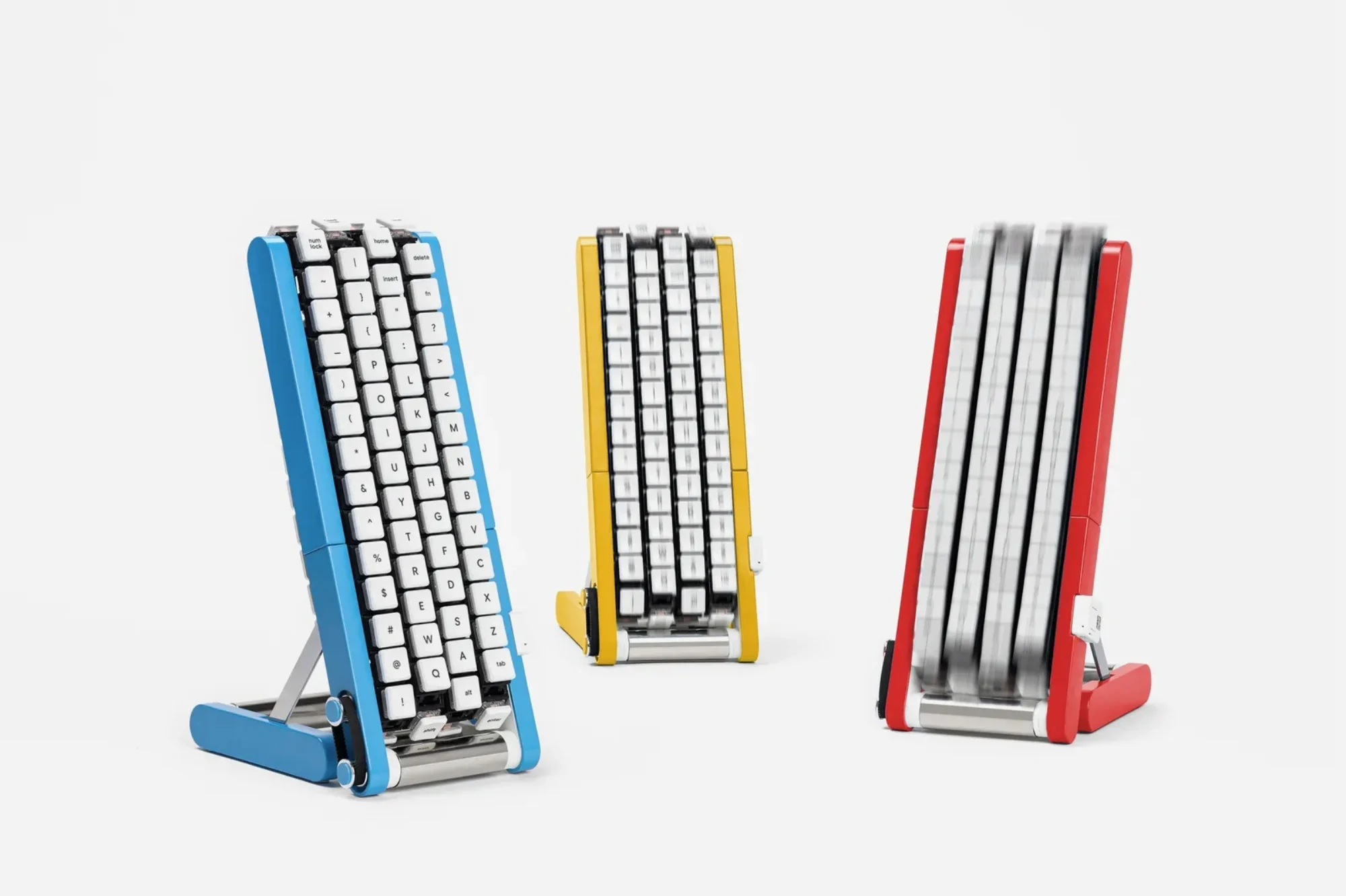
The Gboard Conveyor Belt Version is a physical keyboard prototype developed by Google Japan that automates finger reach by continuously delivering keys directly to the typist. Belonging to Google Japan’s hardware design experiments, the peripheral addresses the ergonomic issue of excessive hand movement associated with standard flat desktop typing interfaces.
Key Facts
The Gboard Conveyor Belt Version redesigns mechanical input by mounting keys onto moving motorized tracks. Rather than forcing hands across a wide horizontal surface, the vertical layout brings 116 mechanical inputs directly to resting fingertips through mechanical loop cycles.
Attribute Value
Manufacturer Google Japan
Product Category Novelty computer keyboard / Open-source hardware prototype
Orientation Vertical desktop standing unit
Conveyor Belt Count 4 continuous rotating belts
Keys Per Belt 29 rotating keys
Total Key Count 116 rotating keys (29 keys across 4 belts)
Release Date October 1 (timed to reference standard 101-key keyboards)
Preceding Prototype Rotary dial Gboard (released the previous year)
Commercial Availability Not sold as a commercial consumer product
Hardware Blueprints Open-source blueprints published on GitHub (google/mozc-devices)
Retail Price Unknown (not manufactured for commercial retail sale)
Physical Dimensions Unknown (exact height, width, and depth not specified)
Google Japan designed the Gboard Conveyor Belt Version with four rotating belts that each hold 29 keys to deliver inputs directly to resting hands.
How Does the Gboard Conveyor Belt Version Work?
The Gboard Conveyor Belt Version operates vertically on a desk rather than resting flat, utilizing four motorized belts that continuously cycle 29 keys each downward toward the operator. This downward stream brings characters directly to stationary fingers, reducing the physical reach required to press conventional alphanumeric keys.
By bringing inputs continuously toward the user’s hand, Google Japan designed the prototype to test whether automated key delivery enables more efficient and intuitive text input. In demonstrations, Google highlighted that the compact footprint facilitates one-handed typing, leaving the user’s secondary hand entirely free to operate a mouse.
“developing hand-eye coordination” Google Japan
Google Japan also showcased experimental variants of the concept, including lengthened layouts capable of accommodating larger character sets, condensed portable configurations suited for mobile use, and an accelerated high-speed mode intended for training typing reflexes.
The vertical Gboard prototype uses four continuously revolving belts carrying 29 keys each to eliminate lateral finger travel during typing.
Who Is This For?
The Gboard Conveyor Belt Version is intended for hardware enthusiasts, open-source builders, and typists interested in novel single-handed input ergonomics. Because Google Japan does not sell completed production units, the physical device is exclusively accessible to makers willing to fabricate their own hardware using public GitHub design files.
The device caters directly to two distinct functional workflows outlined by Google Japan:
Single-handed workstation operators: Typists can input text with one hand while continuously navigating desktop interfaces with a dedicated mouse. Dual-unit power typists: Ambitious users can place two separate conveyor belt units side by side to operate both hands simultaneously across eight independent motorized belts.
Hardware makers can construct a functioning Gboard Conveyor Belt Version independently using public schematics hosted in Google’s Mozc repository.
Common Questions
Can consumers purchase the Gboard Conveyor Belt Version?
Consumers cannot purchase the Gboard Conveyor Belt Version because Google Japan does not manufacture or sell the keyboard as a commercial retail product. Instead, the company published open-source fabrication blueprints on GitHub within the Mozc repository for independent maker construction.
Why does Google Japan release novelty keyboards on October 1?
Google Japan shifted its annual keyboard reveals from April Fool’s Day to October 1 as a deliberate numerical reference to standard 101-key computer keyboards. The company has maintained this hardware innovation showcase tradition for more than ten consecutive years.
What previous keyboard concept preceded the conveyor belt version?
Google Japan released a rotary dial Gboard prototype the previous year, replacing standard push buttons with circular telephone-style dials. The conveyor belt model was conceived to reduce the substantial hand movement required to dial individual characters on that prior design.
Google Japan releases its experimental keyboard designs annually on October 1 in homage to the traditional 101-key computer keyboard standard.
Sources and Methodology
This technical overview synthesizes reporting published by technology outlet Lowyat.NET and official announcement documentation from Google Japan’s official product blog and Mozc open-source repository. No speculative technical specifications or commercial pricing details were extrapolated beyond facts confirmed in primary documentation. This article was last updated on October 5, 2026.
Technical specifications for the Gboard Conveyor Belt Version derive directly from Google Japan’s official product announcements and GitHub repositories.
Related coverage
More More tech →Filed under
- #Gaming
- #News
Network · latest from sister sites